Ancash, Peru · October 22, 1987
Ana
Masias
Visual artist, independent curator, educator, and visual arts researcher.
Presentation
Memory, resistance
and color
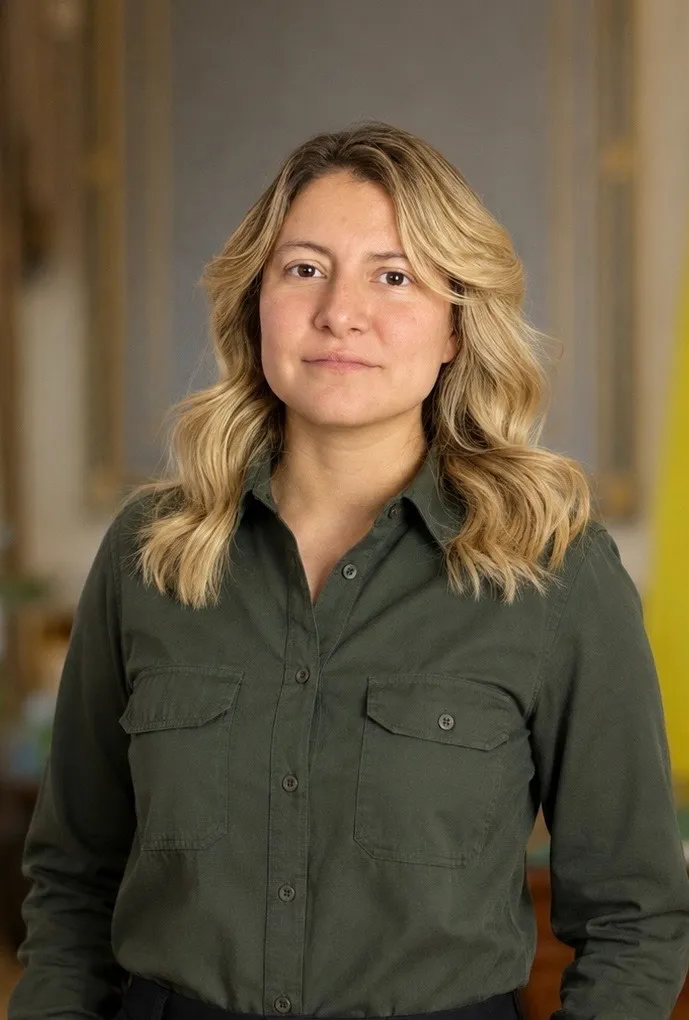
Ana Masías (Ancash, Peru, October 22, 1987) is a Peruvian visual artist.
Her early years were spent between Lima, Peru, and Mexico (1992-2001), specifically between Mexico City and Mérida, Yucatán, in an environment marked by the coexistence of different Latin American cultural traditions and the intense academic and intellectual life of her parents. Ana is the daughter of Ana Bendezú, a psychologist, university professor, and researcher specializing in human sexuality, and Rodolfo Masías, a political scientist, sociologist, and university professor. Both completed their undergraduate studies at the Pontificia Universidad Católica del Perú (PUCP) and postgraduate studies at the National Autonomous University of Mexico (UNAM), the Latin American Faculty of Social Sciences (FLACSO), and El Colegio de México.
Growing up in an environment of intellectual debate, reading, and reflection on social phenomena awakened an early interest in visual culture, history, and artistic expressions, which would later converge in her training as an artist. Upon returning to Peru, she began her academic education at PUCP, studying in the faculties of General Studies Letters and Art and Design. During those years, she developed a practice that combined pictorial production with an interest in research, a relationship she would later consolidate through a Master's degree in Art History and Curatorial Studies (PUCP).
Following a relationship that began in 2014, she married the renowned Peruvian painter José Tola (1943-2019) in 2019. His influence provided her with the technical tools and necessary experience to define her path as a painter.
Ana Masías's work develops in the field of contemporary painting and is characterized by a constant dialogue between artistic practice and research. Her production incorporates references to memory, identity, the representation of the body, the cultural history of the Global South, and the processes of symbolic construction, establishing links between personal experience and collective imaginaries. Her painting explores the human consequences of contemporary violence, war, forced displacement, exile, and loss, addressing these themes from a perspective centered on the human experience rather than specific historical events. Her work proposes a narrative painting where the human figure occupies a central place as a vehicle to represent vulnerability, memory, and resistance. Through scenes of a symbolic nature and compositions constructed from imagination, her works establish relationships between individual experiences and conflicts that transcend national borders, taking contemporary humanitarian crises and the effects of war in different geopolitical contexts as references. Her training has influenced a working methodology in which theoretical reflection and pictorial production develop in parallel.
Her interest in the history of Latin American art is also evident in her academic research. Her Master's thesis, dedicated to the work of Mexican artist Enrique Chagoya, studies the relationship between iconography, historical memory, and decolonial aesthetics—interests that dialogue with her own artistic practice through the incorporation of cultural references, symbolic appropriations, and reflections on the construction of Latin American identity.
Research · Inspiration
The persistence of color
Inspiration from pre-Hispanic textiles
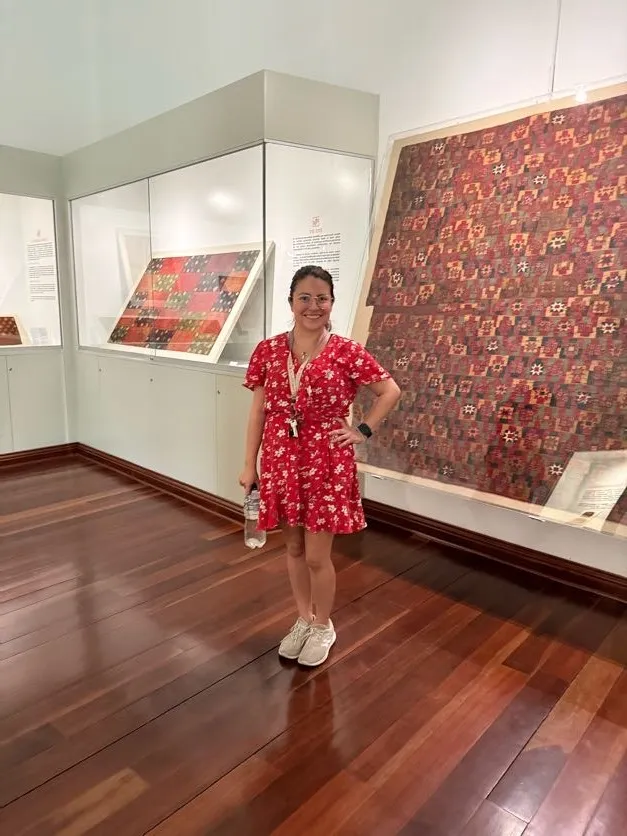
Walking through the Ancient Peru Garments hall in the museum, standing before the imposing mastery of pre-Columbian weavers. Contemplating the complexity of the unkus, mantles, and sashes is not just a journey into the past; it is a living lesson in design and technology.
The mastery of raw materials and the chemical experimentation that allowed them to obtain more than 120 shades of color—whose fastness continues to defy the passage of centuries—is a constant source of wonder and inspiration for my own chromatic search in the studio. Andean textile art reminds us that color and weave are eternal visual languages.
Interview · Media
Somos Cultura
Interview with Ana Masias on the program «Somos Cultura» by Radio Nacional del Perú, reflecting on her artistic journey, creative processes, and the solo exhibition «Between heaven and earth».
Education
- 2023 Master's in Art History and Curatorial Studies, Pontificia Universidad Católica del Perú (PUCP)
- 2019–2021 Master's Studies in Art History and Curatorial Studies, PUCP
- 2008–2015 Bachelor of Visual Arts, Faculty of Art and Design, PUCP
- 2005–2006 Studies at the Faculty of General Studies Letters, PUCP
Awards & Distinctions
- 2017 Winner of the Bachelor Thesis Development Support Program (PADET-PUCP). Project: I Indian, I Spaniard; decoloniality, woman and mestizaje from Expanded Graphics
Teaching Experience
- 2022–2024 Professor, National Superior Autonomous School of Fine Arts of Peru. Courses: Curricular Design and Programming, Interdisciplinary Spaces II, Analysis of Creative Processes IV and V, Performative Arts Seminar
- 2018–2025 Professor, Corriente Alterna School of Visual Arts. Courses: Experimental Printmaking, Portfolio and Project Management and Initiative, Basic Workshop on Thought Structure, Project Management and National Cultural Challenges
- 2016–2019 Assistant and collaborator at José Tola de Habich's studio (El Taller Amarillo S.A.C.)
Curatorial Experience
- 2022 Maravillarte. Cultural Center of the Ministry of Culture, Kuéllap I and II Rooms. Exhibition-contest featuring more than 350 artists
- 2020 José Tola: Non Omnis Moriar. Cultural Center of the Beneficencia de Lima. Curation of José Tola's work and his international graphic work collection
Solo Exhibitions
- 2026 Entre el cielo y la tierra — MAD - Andrés del Castillo Minerals Museum, Lima
Group Exhibitions (Selection)
- 2025Manifiesto del Vacío. Pintura peruana contemporánea Vol. 1 — Metropolitan Museum of Lima
- 2025Desde la diversidad creativa — Minerals Museum of Lima
- 2024White Noise Vol. II — Martín Yépez Gallery, Lima
- 2024White Noise Vol. I — Espacio Basadre, Lima
- 2024Delirios de una tarde de verano — Espacio Tierra Baldía, Lima
- 2023Nuevas Propuestas — Martín Yépez Gallery, Lima
- 2023Carnación — Librería Vallejo, Lima
- 2023La otra cara de la expresión — Librería Vallejo, Lima
- 2023Palestina y Perú, la tierra y la mujer — Palestinian Arab Club, Lima
- 2022Largest Mural in the World — VIII OMAI Summit, Sinaloa, Mexico
- 2022A la luz de las mujeres — Ccori Wasi, Lima
- 2022Silencios que hablan — Radisson Hotel, Lima
- 2022Mirada de mujer — VICUS, Piura
- 2022Maravillarte — Ministry of Culture, Lima
- 2021Venus: Deidad, maternidad, feminidad — José Antonio Gallery, Lima
- 2021Mirada de mujer — José Antonio Gallery, Lima
- 2019Girando sobre lo que se encuentra entre nosotros — University of the Arts, Guayaquil, Ecuador
- 2017GIFmi one more time — Casa Bagre, Lima
- 2017XIII Human Rights Encounter. Re-thinking gender — PUCP
- 2016Curar desde la precariedad — Bisagra, Lima
- 2014Estamos locxs: Un juicio sobre la violencia de género — PUCP
- 2012Universo Denso — Miraflores, Lima
- 2010Grabado: Espacios Liberados — ICPNA San Miguel, Lima
- 2008–2015Annual Art Exhibition — PUCP
Cultural Management
- 2018 Jury, Horacio Zeballos Award by Derrama Magisterial, Painting category
Bibliography as Author
- 2023El Popol Vuh de la Abuelita del Ahuizote, «decolonial aesthetics» in the work of Mexican artist Enrique Chagoya — PUCP
- 2021Interview with Enrique Chagoya
- 2020The José I loved — Diario Expreso
- 2019I think we were always connected — Cosas Magazine
- 2018Contemporary Colonials — Blog
- 2017I Indian, I Spaniard — Rinoceronte Magazine
Research & Archive
- 2023 Master's thesis: El Popol Vuh de la Abuelita del Ahuizote. Research on decolonial aesthetics and the digital work of Enrique Chagoya, developed from iconographic and iconological analysis.
- 2010–2024 Archive of work and publications. View artworks, processes, and texts published by Ana Masías.
Press and Media
- 2026Diario Oficial El Peruano: «Ana Masías holds exhibition with tribute to José Tola»
- 2026Diario Oficial El Peruano: «Painting as refuge and memory: Ana Masías presents 'Between Heaven and Earth'»
- 2026Radio Nacional del Perú: «Interview with Ana Masias on Somos Cultura program»
- 2026Diario Expreso: «Opinion column on 'Between Heaven and Earth'»
- 2026Diario Correo: «Ana Masías presents the exhibition 'Between Heaven and Earth' at the Museo Andrés del Castillo»
- 2026Cuenta Artes: «Visual artist Ana Masías presents Between Heaven and Earth»
- 2026Andina: «Painting as refuge and memory: Ana Masías brings us Between Heaven and Earth»
- 2026Lima Gris: «Ana Masías turns painting into an act of resistance»
- 2025La Guía de Arte Lima, edition 369: «Interview with Ana Masías»
- 2022Lima Gris: «Maravillarte in my Peru»
- 2021El Comercio: «Venus: deity, motherhood, femininity»
- 2020Somos: «Tola life»
- 2019Cosas Magazine: «I think we were always connected»