Curatorial Text
Painting as a territory of memory and time
Every painting is a negotiation with time. Before becoming an image, it is an accumulation of decisions, rectifications, doubts, and permanences that overlap on a support until they constitute a visible form. Each gesture records an unrepeatable instant of the artist's thought and body, but also incorporates the memory of those who preceded them. To paint is, therefore, to face a complex temporality: one in which the present gesture coexists with the past of images and with the possibility of future interpretations. In this sense, painting would not be a mere event; it constitutes a space where time acquires materiality.
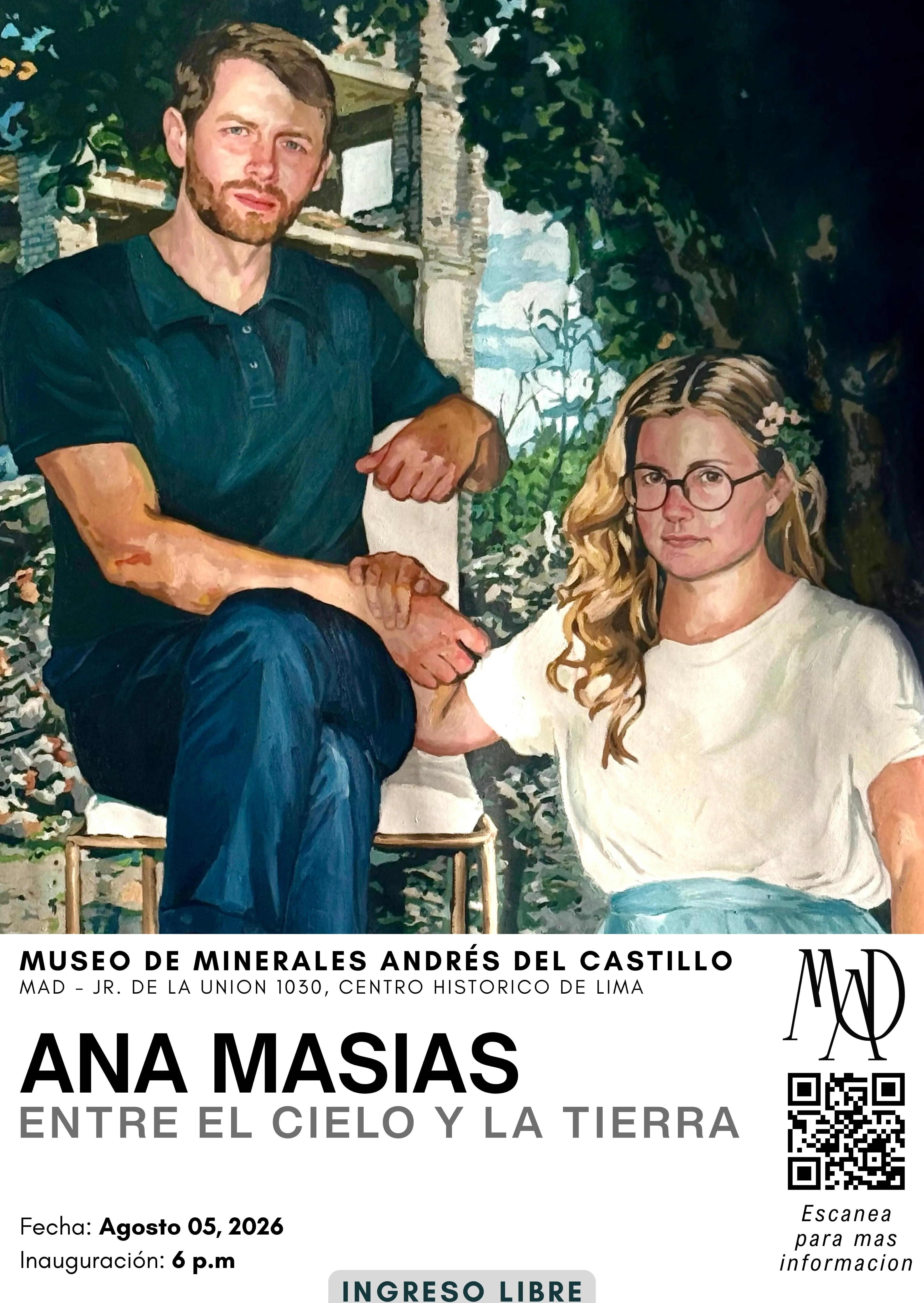
The exhibition Between heaven and earth starts from that temporal condition to propose a reflection on human experience in a world marked by violence, displacement, and the incessant circulation of images. Far from proposing a documentary account or a historical reconstruction of specific conflicts, the works gathered in this exhibition construct a visual universe where different memories seem to overlap without ever being completely resolved. Their characters, architectures, and landscapes refer to recognizable events, but remain deliberately open, suspended between evocation and uncertainty. What emerges is not a closed narrative, but a constellation of images that invites the viewer to complete relationships from their own experience.
This open condition of painting finds a philosophical antecedent in Maurice Merleau-Ponty's reflection on the work of Paul Cézanne. In Cézanne's Doubt, the philosopher argues that painting does not consist in illustrating a previously conceived idea, but in discovering by painting a way of making visible that which does not yet possess a definitive formulation (Merleau-Ponty, 1945/2013). Painting appears then as a process of knowledge rather than as the simple representation of an external reality. Each decision on the canvas remains traversed by uncertainty, no gesture completely closes the meaning of the image.
This phenomenological understanding could bring us closer to Masías' work. The artist does not seek to fix a univocal interpretation of the events they evoke. On the contrary, each image seems to preserve an open process where different temporalities remain simultaneously active. The represented scenes do not entirely belong to the past or the present; they exist in an intermediate space where memory, imagination, and contemporary experience mutually contaminate each other. That intermediate space is Between heaven and earth. It is not just a spatial or metaphorical reference, but an ontological condition. The "between" designates a territory where no identity remains completely stable: between life and death, between presence and absence, between memory and forgetting, between document and fiction, between past and future, between the space we inhabit and the one we do not. It is in that interval where painting acquires the capacity to ask questions.
David Joselit thinks of painting from the contemporary conditions of image circulation. In his essay "Marking, annotating, storing and speculating (on time)", the author argues that contemporary painting can no longer be understood solely as an autonomous object, but as a node within much broader networks of visual production, archiving, and circulation (Joselit, 2016). Images cease to exist solely on a canvas to continuously move between museums, digital platforms, photographic archives, mobile devices, and individual memories. Today we contemplate a work knowing that it will probably be photographed, shared, stored, and reproduced countless times. The pictorial image no longer ends on the surface of the painting; it continues to exist as a digital archive, as a memory, as a screenshot, or as a photograph. Consequently, contemporary painting simultaneously participates in two temporalities: the material duration inscribed in the painter's work and the speed with which images circulate in digital culture. As Joselit (2016) points out, we live immersed in a visual economy where images no longer exist as isolated objects, but as elements that circulate and acquire new meanings as they traverse different distribution networks. Circulation becomes a constitutive condition of the contemporary image. However, faced with the speed with which these images appear and disappear on digital devices, painting proposes another temporality: a slower experience, where looking implies remaining.
Masías' production could dialogue with this condition. Some of her compositions seem to be built precisely from that heterogeneous accumulation of visual memories. But these dispersed references that appear in the paintings do not constitute literal quotes, but fragments that have been transformed through pictorial work until they acquire a new sensitive condition. They are references reorganized to produce new affective relationships. Although many of the images evoke scenarios associated with war, displacement, or ruins, none intends to reconstruct a specific event. Historical references remain deliberately displaced, allowing painting to situate itself on a plane where human experience acquires a universal scope. Georges Didi-Huberman (2018) has pointed out that images possess the capacity to survive the contexts that originated them and establish unexpected relationships with other images from different times. Visual history does not advance linearly; it is built through survivals, displacements, and constant reconfigurations. This fragmentary condition does not respond to a desire for gratuitous ambiguity. It constitutes a way of thinking about memory. The paintings gathered in Between heaven and earth do not illustrate memories; they construct scenarios where memory continues to be produced. At this point it is pertinent to return to Merleau-Ponty. For the philosopher, painting does not simply reproduce the visible world; it reveals the process by which the world comes to be visible to us (Merleau-Ponty, 1945/2013). The gaze does not passively record an already constituted reality, but participates in its appearance. This idea allows us to understand why Masías' works do not seem like closed narratives. Their meaning is completed in the viewer's perceptual experience. Each observer establishes different connections between the represented elements, activating new relationships between memory, history, and imagination.
Between heaven and earth does not designate only a physical space, but the existential condition of being and inhabiting. Inhabiting a territory crossed "between" hope and loss, by construction and destruction, permanence and change, violence and love. More than representing a world, these works build a place to think about it. Painting appears as a form of knowledge capable of gathering what the speed of contemporary visual culture usually disperses: the time of contemplation, the persistence of memory, and the possibility of establishing affective bonds with images that, even coming from distant contexts, continue to interrogate our own experience. In a historical moment marked by the massive circulation of information and the rapid obsolescence of images, Between heaven and earth claims the capacity of painting to produce a different experience of time. Not because it opposes contemporaneity, but because it introduces a pause within it. Each painting becomes a place where the past remains unfinished, the present continues to be questioned, and the future remains open to new interpretations. Therein lies perhaps one of the most profound functions of contemporary painting: not to offer certainties, but to sustain the possibility of continuing to look when images seem to have exhausted everything they could say.
References
- Didi-Huberman, G. (2018). Ante el tiempo. Historia del arte y anacronismo de las imágenes. Adriana Hidalgo Editora.
- Joselit, D. (2016). Marking, annotating, storing and speculating (on time). In Painting 2.0: Expression in the Information Age. Museum Brandhorst.
- Merleau-Ponty, M. (2013). La duda de Cézanne. In Sentido y sinsentido (original work published in 1945).
- Rancière, J. (2010). El espectador emancipado. Manantial.